FedEx: Businesses Struggle to Turn Supply Chain Data Into Useful Insights
 Chris Crum writes for SBR about What's Hot in Small Business. Chris was a featured writer with the iEntry Network of B2B Publications where hundreds of publications linked to his articles including the Wall Street Journal, USA Today, LA Times and the New York Times.
| |
|
With growing supply chain pressures, businesses need actionable data insights, analytics, and AI to stay competitive, according to findings from a recent FedEx report.
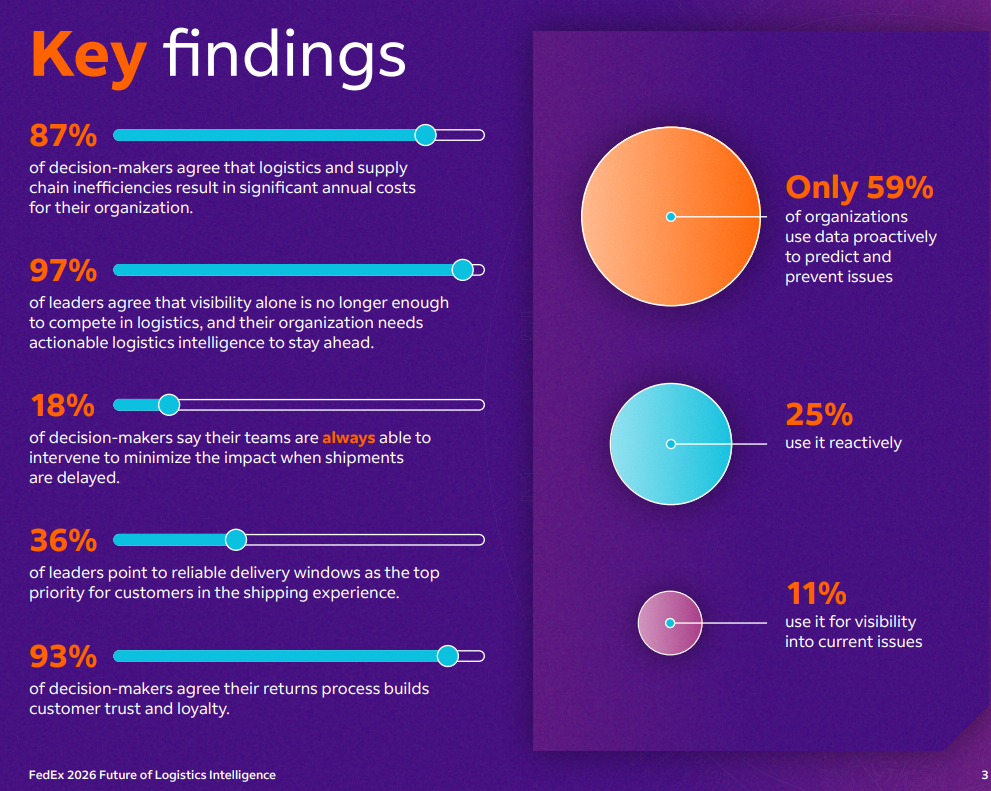
FedEx recently released its Future of Logistics Intelligence Report, finding that 97 percent of business leaders indicate that visibility alone is no longer enough to stay ahead of competition. Rather, turning logistics data into actionable insights, supported by analytics and AI, is key amid growing supply chain pressures. It also found that many businesses are struggling to turn supply chain data into insights that they can actually use. Most organizations have achieved end-to-end shipment visibility, but far fewer can turn that data into the insights and actions needed to stay competitive in today’s environment. Jason Brenner, Senior Vice President, Digital Portfolio at FedEx, commented, “Many organizations can see what’s happening in their supply chains, but leaders in the space can predict and act fast enough when it matters most. Closing the gap with logistics intelligence, supported by analytics, AI and close partnerships with your carrier, will help organizations move from reacting to disruptions to anticipating them, minimizing impact, and delivering a leading customer experience.” According to the report, most leaders are confident in their ability to track shipments, but there is a gap between what organizations can see and what they can do. Only 59 percent say they use data proactively to predict and prevent issues. Twenty-five percent claim to use it reactively, and 11 percent use it for visibility into current issues. Just 18 percent say their teams are always able to intervene when shipments are delayed. Below are some additional key findings.
On the consumer end of things, expectations for reliability, transparency, and proactive communication are accelerating the need for logistics intelligence at every touchpoint. Thirty-six percent of decision-makers say consumers prioritize reliable delivery windows, while 34 percent say they prioritize end-to-end shipment tracking. The report found that limited visibility and delivery delays remain the most common shipping-related complaints. Businesses see higher costs to serve (53 percent), increased strain on service teams (47 percent), and more customer complaints (46 percent) as a result of delays. Forty-three percent of business leaders polled strongly agree that their logistics systems are future-proof, indicating they can adapt to shifting customer expectations, compliance demands, and market conditions. The FedEx report points to modernized and connected systems, as well as AI-powered insights as the foundation for future readiness for businesses. These can help predict disruptions earlier, reduce manual work, and enable speedier responses. “Being ready for what’s next, building long-term resiliency, and competitive differentiation require investing in systems that go beyond meeting today’s needs,” Brenner said. “Connected data, analytics, and AI are essential to making that shift. At FedEx, we’re making supply chains smarter through our suite of data-powered digital solutions that support our customers’ growth and help them become more future-ready.” As small businesses compete with their peers as well as bigger players, understanding logistics-related insights is becoming more and more critical with rapidly evolving technology. Utilizing the right tools and analytics can help overcome supply chain challenges. Image credit: https://www.fedex.com/en-us/digital/blog/2026-future-of-logistics-intelligence-report.html?utm_source=fedex&utm_medium=pr&utm_campaign=logistics-intelligence-report-2026&utm_content=logistics-intelligence-report-2026 |
|